We are excited to announce that the Law Office of Paul Gattone is now the Arizona Civil Rights Law Center (ACRLC). Same dedicated team. Same mission of advocacy. New name, reflecting what we do and our vision for the future.
Police violence robs people of dignity, safety, freedom, and sometimes their very lives. In 2025 alone, police in Arizona killed 60 people–and that doesn’t scratch the surface of non-lethal misconduct. Whether it’s local police or ICE and border patrol, everyday people suffer serious injury, unwarranted jail time, and loss of livelihood when law enforcement goes unchecked.
We understand the impacts of a bad interaction with law enforcement can ripple out to affect the rest of someone’s life, commonly leading to a permanent distrust of those in uniform. The officer may carry on business-as-usual, but the client’s life is changed forever.
Police brutality and false arrests can happen to anyone. Stay-at-home moms, college students, 70-somethings, nurses, and business consultants have all contacted us with a common need: bringing accountability to officers who abused their power. We don’t let those officers sweep abuse under the rug.
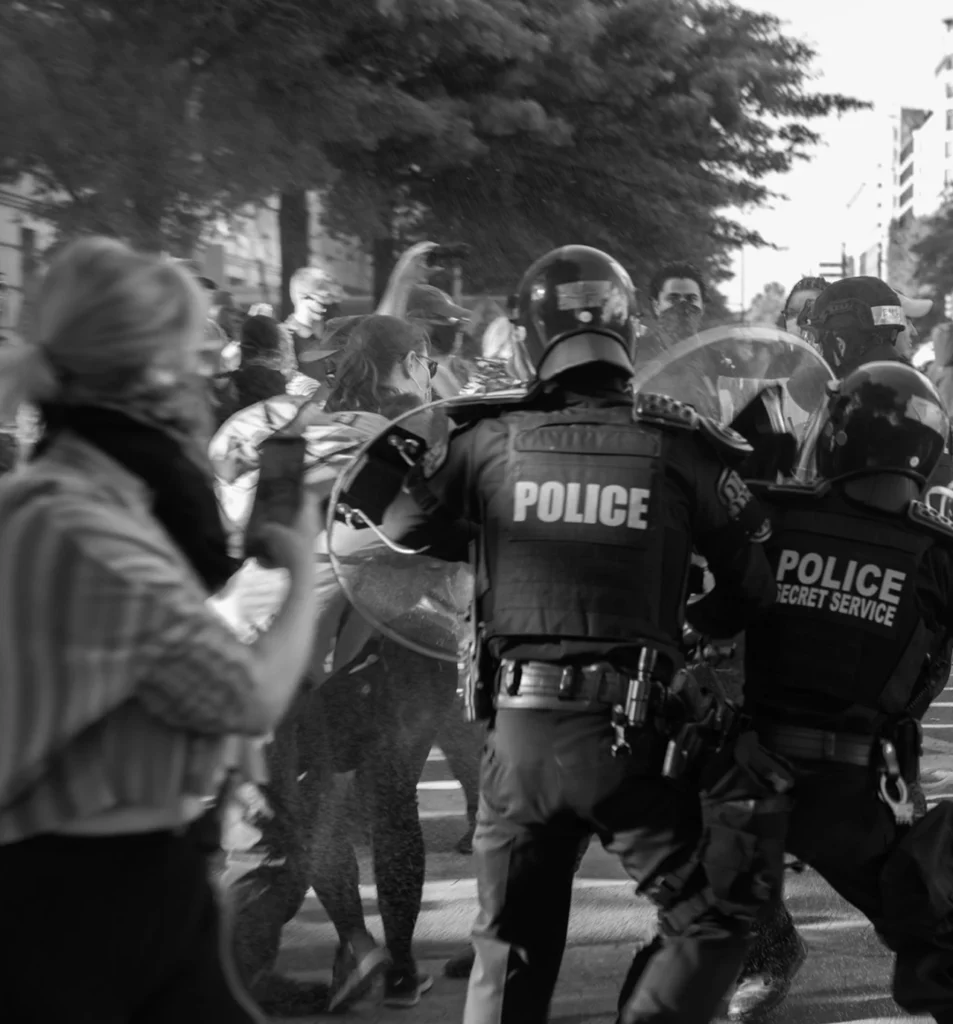
We use “police misconduct” as a shorthand for the abuses committed by all law enforcement. For us, “police” includes campus police, highway patrol (i.e., state troopers), corrections officers, Sheriff’s deputies, and federal agents employed by ICE, Border Patrol, and the Department of Homeland Security (DHS). Police misconduct comes in many forms, including excessive force, unlawful retaliation, and prolonged traffic stops. Below are some examples of the types of police abuses we help with:
This can include when an officer shoots, tases, punches, body slams, deploys a police dog (i.e., K-9), or uses a high-speed vehicle maneuver (sometimes called “PIT” maneuver). After someone is detained, excessive force can also happen in the manner of restraint, such as forcing a suspect face-down or placing bodyweight on them (i.e, “positional asphyxia” in the “prone” position). Just because a weapon is ‘less lethal’ does not make it lawful: pepper spray, pepperballs, teargas, rubber bullets, and beanbag rounds are examples.
Even when a cop doesn’t pull the trigger, they sometimes violate the Fourth Amendment by merely pointing their gun. For example, during a traffic stop, an officer cannot point his gun at a driver who is following instructions, safely pulled over, and poses no danger.
A person does not lose their constitutional rights simply because they are accused of a crime. Corrections officers should be held accountable for excessive force to the same extent as any other officer.
Southern Arizona is home to thousands of uniformed Border Patrol agents. Both citizens and noncitizens are protected from excessive force and unlawful searches. This includes during Border Patrol traffic stops (known as ‘roving patrols’), during protests, and at Arizona’s more than 15 interior checkpoints.
Protest and public advocacy are central to movements for social justice. The First Amendment protects free expression, whether that be in the form of direct action, online postings, or filming police. Officers cannot arrest, handcuff, or intimidate civilians simply because they have made offensive comments or declined to help an investigation.
There are hundreds of traffic rules. For this reason, an officer can easily find a ‘legitimate’ basis to stop a vehicle. These so-called pretextual stops are not illegal. However, a traffic stop can become unlawfully prolonged when an officer investigates unrelated details based on hunch, such as looking into a person’s immigration status.
With few exceptions, cops cannot enter the home without either a warrant or permission. Homeowners, renters, and house guests all share this protection in the home. The Fourth Amendment also protects “curtilage” – the land immediately surrounding the home, such as partially enclosed or partially fenced areas.
This can include when an officer shoots, tases, punches, body slams, deploys a police dog (i.e., K-9), or uses a high-speed vehicle maneuver (sometimes called “PIT” maneuver). After someone is detained, excessive force can also happen in the manner of restraint, such as forcing a suspect face-down or placing bodyweight on them (i.e, “positional asphyxia” in the “prone” position). Just because a weapon is ‘less lethal’ does not make it lawful: pepper spray, pepperballs, teargas, rubber bullets, and beanbag rounds are examples.

Take the first step toward resolution. Fill out our secure intake form below to share the details of your situation, and our team will review your information promptly.
When an officer commits abuse, the law enforcement community often minimizes it as the regrettable actions of ‘just one bad apple.’ However, as the saying goes, one bad apple ruins the bunch. We see that individual officers are part of a broader workplace culture rooted in systemic oppression that trains, rewards, and excuses the kinds of abuses our clients face.
Too often, officers misrepresent events in their reports and supervisors make excuses on their behalf. We don’t take the cop’s word for it. When our office takes on a case, we start by listening to the client’s story, whether they were the target or a loved one of someone killed by law enforcement.
Then, we ruthlessly investigate the circumstances leading up to the abuse. We seek out patterns to see if the law enforcement agency had a history of similar behavior. We demand body-worn camera footage, surveillance videos, 911 audio, internal communications, written reports, and information about the agency’s chain of command and training practices. Then we take the fight to court, drawing on our expert knowledge to develop a litigation strategy that advances our clients’ vision of justice. From the beginning to the end of each case, we stand up to law enforcement agencies with everything we’ve got.